
CWP Blog | CWP
The Special Exposure Cohort Explained: A Guide for Workers
June 12, 2026
June 12, 2026
CWP
CWP Blog
Decades ago, thousands of workers were exposed to radiation while helping build and fuel America’s defense programs, often without full knowledge of the risks. Today, the Special Exposure Cohort (SEC) exists to recognize that reality. If you meet certain work criteria and have been diagnosed with one of 22 specific cancers, you may qualify for compensation without having to go through the difficult and time-consuming process of radiation dose reconstruction. For many families, that one difference can mean faster answers, fewer obstacles, and access to benefits they didn’t even know they were entitled to.
Here are five things that you need to know about the SEC:
1. What it Means (And Why It Matters)
Under the Energy Employees Occupational Illness Compensation Program Act (EEOICPA), most workers must go through dose reconstruction—a complex scientific process used to estimate past radiation exposure when monitoring records are incomplete.
That process can take months (or longer) and doesn’t always work in your favor. The SEC changes that. If you meet the criteria established by the U.S. Department of Labor (DOL):
- You are presumed to have received enough radiation exposure to cause your illness.
- You skip dose reconstruction entirely.
- Your claim can be approved much faster and with fewer obstacles.
For many families, this difference can mean faster financial compensation, quicker access to medical benefits, and less stress when navigating the system.
2. Who Qualifies for the SEC
The SEC applies to specific groups of workers who were employed at the U.S. Department of Energy sites, atomic weapons facilities, or related contractor locations during time periods when radiation monitoring was known to be inadequate.
In most cases, eligibility comes down to a combination of your work history and your diagnosis. Workers generally need to have accumulated at least 250 workdays at qualifying sites and must have been diagnosed with one of the cancers recognized under the program. These criteria were designed with nuclear weapons and uranium workers in mind—people whose exposure risks were real, even if they weren’t fully documented at the time.
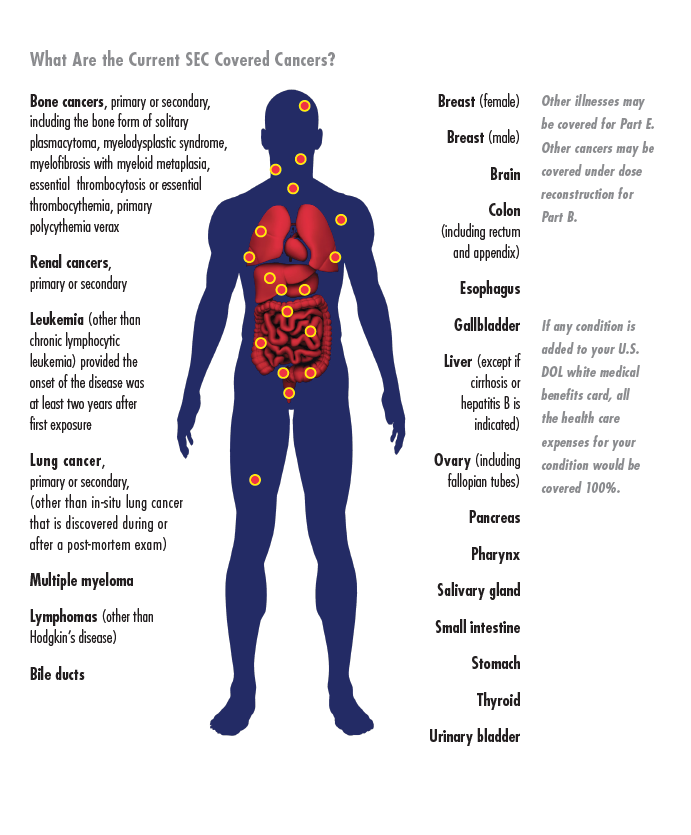
3. Cancers Covered Under the SEC
If you developed one of the 22 specified cancers, your path to benefits becomes much simpler under the SEC.
In many cases, there are latency requirements, meaning the illness must have developed a certain number of years after your exposure.
If your cancer is on the list and you meet the work criteria, you don’t have to prove how much radiation you received. Read more and see the full list of qualifying cancers here.
4. Covered Job Sites and Work Locations
There are over 100 locations that are covered under the SEC. These include some of the major nuclear facilities like Hanford, Oak Ridge, and Los Alamos, as well as many smaller contractor and subcontractor locations. The SEC is structured around “classes” rather than just locations. A single family can have multiple SEC classes if different time periods or worker groups are approved. To see if your work location qualifies and to see details on each designation, visit the U.S. (DOL) website.
5. Maximizing Your Benefits: Compensation and Medical Coverage
Qualifying under the SEC can open the door to meaningful support. In addition to financial compensation and coverage for medical treatment, many workers are also eligible for home care services. As a Cold War Patriots (CWP) Member, you can receive services like these through our home health care division, Professional Case Management (PCM).
If you have a U.S. DOL medical benefits white card, you may qualify for care delivered right in your home. PCM works with eligible patients to coordinate services based on their approved condition, helping ensure they receive the support they need. This can include assistance with daily activities, as well as skilled nursing care, depending on individual circumstances.
For many CWP members, this benefit is life changing. It allows them to remain in their homes while receiving consistent, professional care—and gives families peace of mind knowing their loved one is supported.
To learn more about the Special Exposure Cohort and home care through Professional Case Management, call 855-230-1339 or email us at [email protected]. To read more about the most up-to-date information, qualifying cancers, and locations under the SEC, visit the U.S. DOL website.